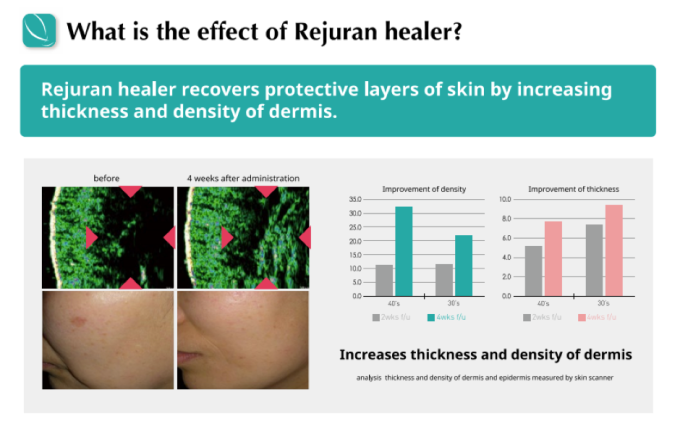
Rejuran Healer is widely regarded as one of the most effective skin booster and anti-aging treatments in dermatology. While its regenerative results are well documented, many patients hesitate due to two commonly mentioned drawbacks: REJURAN pain during injection and temporary skin bumps afterward. Interestingly, both are directly related to the very ingredient that makes Rejuran so effective.
What Makes Rejuran So Powerful

The key ingredient in Rejuran Healer is PN (Polynucleotide), a highly purified DNA fragment derived from salmon. PN activates the skin’s natural healing mechanisms, improves the dermal environment, and restores skin structure from within. Compared to traditional PDRN (formerly known as “salmon injections”), PN has a much larger molecular size and higher viscosity, allowing for deeper, longer-lasting regeneration of collagen, elastin, and dermal cells.
Clinically, this translates into improved skin elasticity, pore refinement, redness reduction, acne scar improvement, and overall skin resilience—making Rejuran a true regenerative skin booster rather than a superficial treatment.
Why Does Rejuran Hurt?

Despite topical anesthesia, patients often feel sharp, stinging sensations during treatment. This is because PN has a very high molecular weight (around 1000 kDa) and thick consistency, which creates resistance as it is injected into the dermis.
- REJURAN Pain is temporary and varies greatly by individual sensitivity
- With proper numbing and technique, most patients tolerate the procedure well
Many patients who initially find it Rejuan painful still continue regular sessions after experiencing visible skin improvement.
Why Does “Embossing” Occur After Treatment?

The raised bumps seen after Rejuran injections—commonly called embossing—are also a direct result of PN’s density. The material remains in the dermis for 2–3 days before full absorption, during which time small elevations appear.
- Embossing usually subsides within 3–7 days
- Thinner skin types may experience longer recovery
Paradoxically, visible embossing often indicates that authentic, undiluted Rejuran was properly injected at the correct depth.
Rejuran is not a miracle cure, but when performed on suitable skin, at the right dose and interval, by an experienced practitioner, it offers exceptional long-term value. Its reputation for pain and downtime reflects the strength of its regenerative mechanism—not a flaw. Before treatment, thorough consultation and accurate diagnosis are essential. When done properly, Rejuran’s only real “side effect” is disappointment if it’s done incorrectly.
[Introduction to Zero Pain Rejuran]


Leave a Reply